Paula Johnson

For the Horizons Spring 2025 issue, Paula’s story serves as a Behind the Scenes recounting of her accident and STARS mission to provide critical care. Backing every life-saving STARS mission is a team of allies and experts — emergency communication specialists, doctors, pilots, flight nurses, flight paramedics, and emergency-response partners — working seamlessly to ensure that patients receive the best and most timely care. Here’s the incredible story of how a life-saving STARS mission played out.
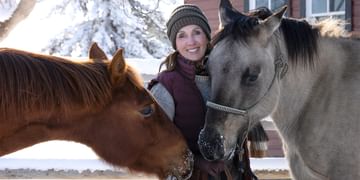
Last July, Paula Johnson was on a horseback ride with friends in the foothills of southern Alberta, near Head-Smashed-In Buffalo Jump. They were ascending a steep hill when her young horse, Star, spooked, and Johnson was thrown off as the horse bolted downhill.
“I’ve been riding my whole life, and I’ve never been thrown from a horse like that,” she said. “My dad was a cowboy, and I heard his voice in my head telling me to take my foot out of the stirrup. I did, then off I went. I don’t remember anything from there, but I’m pretty sure if I hadn’t, I would have been dragged.”
Johnson was knocked unconscious after hitting the ground with potential head and spinal injuries, making her situation critical. Her friends called 911; Alberta Health Services Emergency Medical Services (EMS) collected the information and triangulated the call signal to determine Johnson’s location. Then, Fort Macleod EMS and fire department were dispatched to the scene.
Calling In STARS
The STARS Emergency Link Centre (ELC) was connected to the call.
“The ELC is integrated with EMS, so event details are shared and updated in real-time,” explained John Griffiths, ELC director. “Both agencies began communicating, planning the most effective response, and ensuring all parties knew what was happening.”
Because of limited access to the accident scene and concerns for Johnson’s injuries, helicopter transport was determined to be most advantageous. The STAR‑1 (Calgary) crew had just returned from a call in the same area when they were dispatched to Johnson’s call.
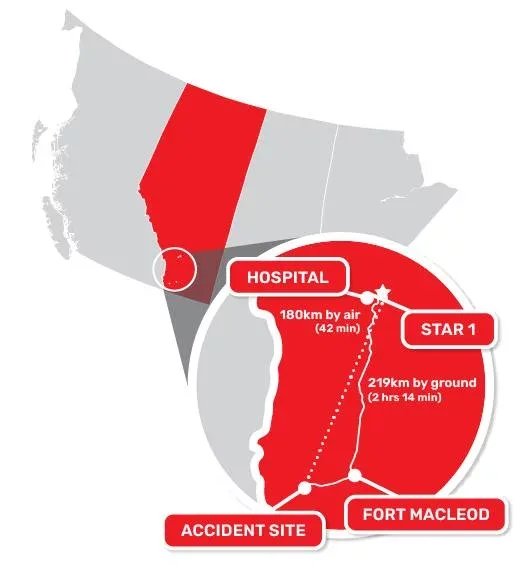
STAR‑1 Mission Summary
12:47 – Mission accepted after pilots evaluate weather conditions
12:48 – Dispatched
13:05 – Leaves Calgary base after refuelling
13:48 – Lands at scene near Fort Macleod
14:04 – Leaves scene with patient safely loaded
14:44 – Arrived at Foothills Medical Centre in Calgary
Making A Plan
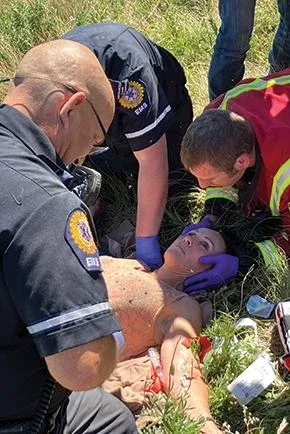
A flurry of activity began: the Fort Macleod Fire Department sent its emergency responders to the scene and tended to Johnson, while EMS assembled at a staging area due to challenging access.
The ELC team of emergency communication specialists also swung into action, supported by clinical oversight by STARS transport physician Dr. Sean Fair. The ELC team pinned Johnson’s location on STARS mapping software and evaluated options for STARS’ response.
Initially, the fire department planned to move Johnson to the ambulance using a side-by-side off-road vehicle, but it was deemed too difficult and could compromise Johnson’s condition. Instead, STARS would land directly at the scene.
Critical Communications and Pre-hospital Care
“Our Link Centre is in constant communication with first responders,” said Griffiths. “EMS flagged that the road gets really rough; there were real concerns with access and that Paula may have a spinal injury. All this information helps determine the best course of action, and that’s how the plan evolved.”
EMS and Fire continued relaying information about the scene and Johnson’s condition so that the ELC could coordinate a safe landing and ensure the air medical crew was fully prepared upon arrival.
Once Johnson was safely aboard STAR‑1, the STARS air medical crew provided ICU-level care in transit, managing her pain and initiating advanced pre-hospital interventions to optimize her outcome. Meanwhile, the ELC kept Foothills Medical Centre informed, ensuring the trauma team was ready the moment she arrived.
The STARS crew safely delivered Johnson into hospital care, where she was treated for a broken collarbone, nine broken ribs, a fractured sternum, a hematoma on her hip, and a brain bleed.
During Johnson’s flight, two other requests for STAR‑1 occurred, which Dr. Fair triaged and assigned to other resources. Johnson’s mission was one of 15 that STARS flew that day — July 31, 2024.
The Recovery
“One day, a helicopter went over my house, and I went out to see if it was STARS. It wasn’t, but I started to cry. I thought, ‘Oh my gosh, I actually rode in a STARS helicopter, and because of that, I survived to walk out on my porch and see another helicopter.’ I’m so thankful for them.”
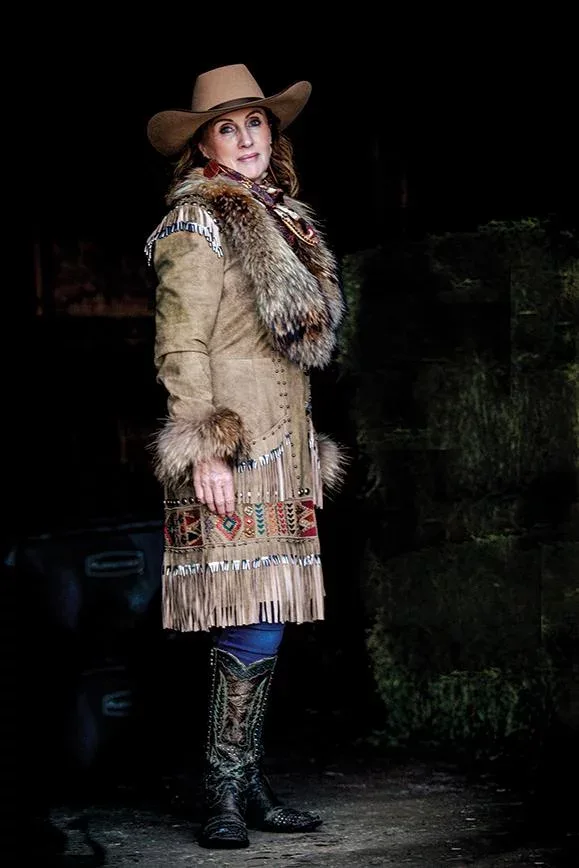
Johnson has since been recovering at her ranch near Longview, Alta. She visited with both the STARS crew and EMS team that rescued her, and they helped her fill in the blanks of what happened.
“They’re so empathetic, caring, and professional. I was just so thankful to meet them and have them help me put the pieces of the puzzle together. Having STARS get me out probably saved my life.”
Donate today to help patients like Paula.